

Is An Infection Indigenous To Animals That Can, On Occasion, Be Transmitted To Humans.
Infections or infestations of animals that can be transmitted to humans are called zoonoses. Although cases of human disease arising from fish and shellfish are rare in Australia, in that location are a few 'fish diseases' that workers in the aquaculture and angling industries need to be witting of when handling or processing fish.
Mycobacteriosis and nocardiosis
Mycobacteriosis and nocardiosis are bacterial diseases that touch on a wide range of freshwater and marine fish, just particularly aquarium fish. The leaner crusade chronic systemic infections that class lesions internally and externally.
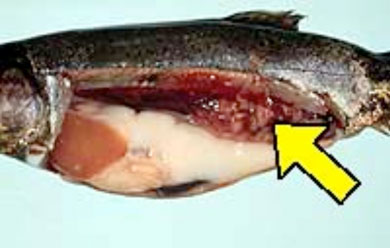
Rainbow trout with mycobacteria lesions.
Afflicted aquarium fish evidence several symptoms such as anorexia, 'popeye', skin discolouration and external lesions such as ulcers, nodules and 'fin rot'. Cold water salmonids may bear witness no external signs of disease other than mortality, but mail service-mortem exam may reveal greyish-white lesions in the kidney, liver and spleen.
In that location is some debate as to whether infected fish can exist successfully treated for these bacterial diseases. The destruction of infected stock and comprehensive disinfection of premises is normally recommended.
Symptoms in humans and handling
Several species of these leaner are capable of infecting humans. The bacteria enters through abrasions which can happen in swimming pools, working with tropical fish aquaria or from handling the guts of infected fish. Peel granulomas of the elbow, knees, fingers and feet may result.
A doc should be consulted as soon every bit possible. The condition may persist for some time and must be treated with antibiotics for an extended period.
Three to iv weeks later on the leaner enters the skin, a swelling develops over a bony lump or the site of an abrasion. A cyst, or abscess, develops that may be filled with pus and may ulcerate and scar. Lymph nodes may likewise swell.
Preventing infection
Clothing protective gloves when cleaning fish aquaria or diving. If you suspect fish may be infected brand sure y'all wear protective gloves when cleaning and filleting fish and disinfect the equipment you use later.
Anisakis worms in the viscera of a blue mackerel
Anisakis nematodes
Anisakis and anisakis-like parasites are common nematode worms, the larvae of which infect many species of locally-caught fish. The parasite is transmitted by a fish eating crustacean zooplankton that is the intermediate host of the parasite, or past preying on a fish that are already infected.
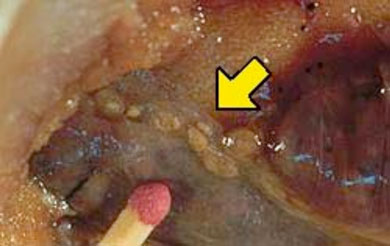
Anisakis worms in the viscera of a blue mackerel.
These parasites take a complicated lifecycle with many intermediate hosts and may be transmitted several times from fish to fish before the final host is reached. The final hosts are marine mammals such as dolphins, whales and seals, where the adult worms cause serious inflammation of the stomach wall.
Anisakis larvae are 10 - l mm in length, white and normally tightly-curled in a cyst in the guts and muscle of the fish. Anisakiasis in humans can be acquired by eating raw or partially-cooked marine fish. The Anisakis larvae cause inflammation to the stomach wall. Some people can also develop an allergy to Anisakis larvae in seafood, even when properly cooked.
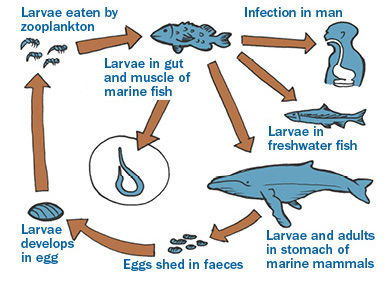
A uncomplicated life cycle of the Anasakis nematode – the adult worm is shown at the centre of the picture show.
Symptoms in humans and treatment
Anisakis can crusade severe gastric and intestinal hurting, vomiting, and diarrhoea. In some severe cases there may be fever and blood in the stools. Anisakiasis is frequently misdiagnosed as breadbasket ulcers or appendicitis. Acute allergic reactions may occur with or without the gastric symptoms. Consult a md as soon as possible.
Preventing infection in humans
Avoid eating raw fish dishes. When cooking fish, melt for a minimum of five minutes at lx degrees Celsius or a shorter time at higher temperatures.
If fish is to exist eaten raw, it should preferably be frozen at -30 degrees Celsius. If storage is at -20 degrees Celsius, the fish should be frozen for at to the lowest degree five days. Information technology is preferable to apply farmed fish for raw dishes as these fish appear to exist near free of infection. Marinating or smoking the fish will non necessarily impale Anisakis.
Crayfish handler'due south disease ('seal finger')
The status known as 'crayfish handler's disease' is well known in the fishing manufacture. Information technology can be acquired by various bacteria, but particularly Erysipelothrix rhusiopathiae and various species of the Vibrio genus.
The bacteria enter the pare through abrasions, lacerations or fissures and cause a painful itching or burning awareness.
Symptoms in humans and treatment
There is an itching, called-for sensation at the site of the injury, followed by swelling and the next joints become stiff and painful. If left untreated the injury volition heal in three weeks, although a relapse at a later date is possible.
There may exist lymph node enlargement and inflammation only this is rare. Consult a doctor as soon as possible.
Preventing infection in humans
Thoroughly clean all marine cuts and injuries with antiseptic and keep them dry and make clean. If handling marine animals, clothing thick protective gloves. Clothing thick boots when wading or fishing.
Source: https://www.fish.wa.gov.au/Sustainability-and-Environment/Fisheries-Science/Aquatic-Animal-Health/Pages/Fish-Disease-And-Human-Health.aspx
Posted by: jinksthourning.blogspot.com
0 Response to "Is An Infection Indigenous To Animals That Can, On Occasion, Be Transmitted To Humans."
Post a Comment